On Learning, Training, and Competence: Notes from a Dima Seminar
I’ve been doing jiu jitsu for 17 years and have never stopped wanting to learn more about how to do it better. A majority of seminars I’ve attended and have taught myself were based on teaching moves that work in competition or a specific part of a system. Now with more and more skill acquisition research making its way to the mats of jiu jitsu coaching, times have changed. One of those people leading the way is Dima Murovanni and his skill acquisition seminars. I was lucky enough to catch one at The Coop in LA.
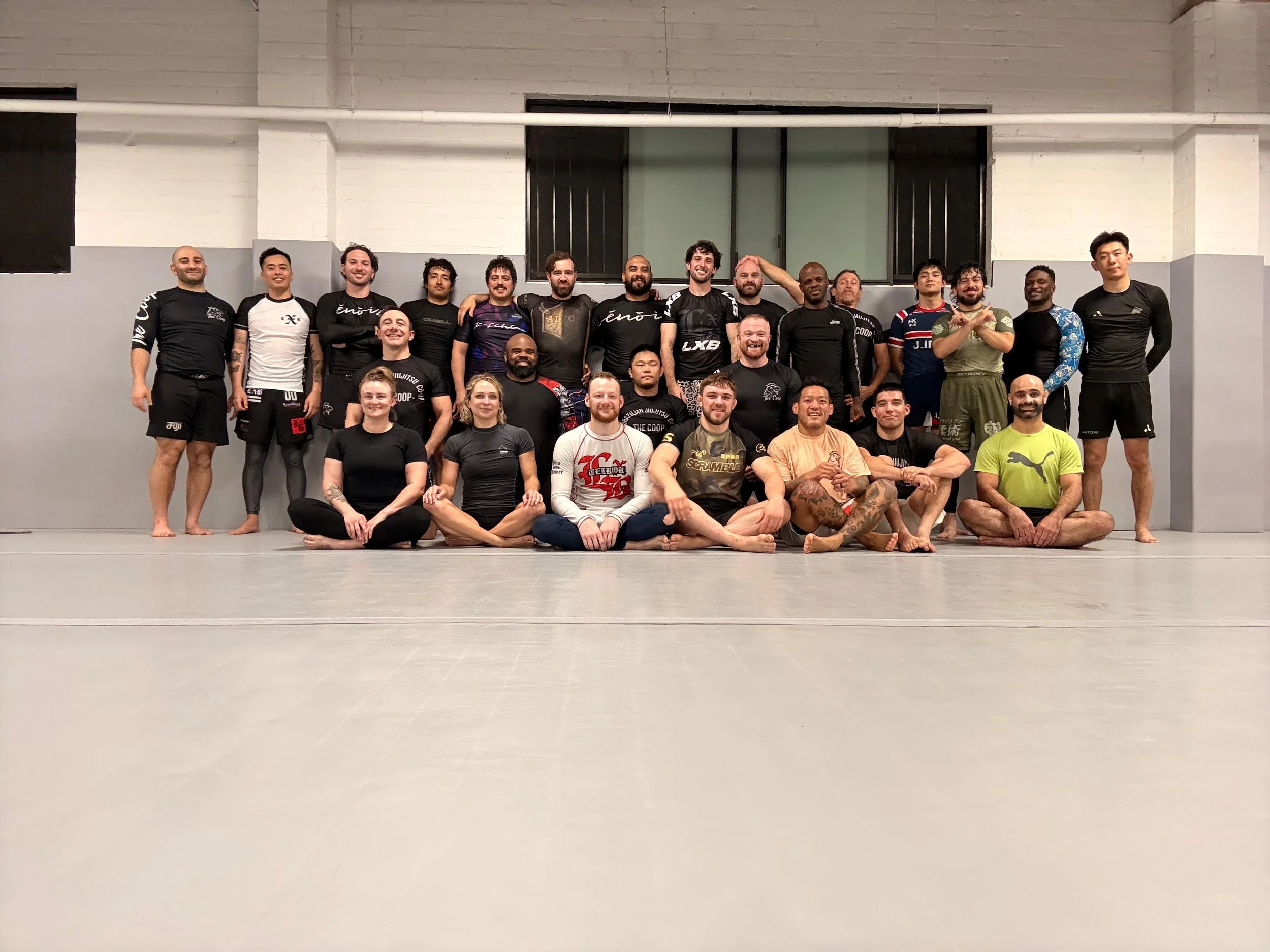
First of all, I had never met Dima before and had only heard about his methods and eco approach through friends. He’s been brought in for high level training camps, worked with the best, and he’s from Germany and that’s about all I knew. So I really didn’t know what to expect. When I saw he was wearing a Terror hardcore rash guard a band I’ve seen many times, I was stoked we had that in common. I invited him to the show next weekend and turns out he wasn’t wearing it for the band, just the level black brand. (He was like who? And I’m like name three songs, poser! 😂
When it started he got straight into it. No formal introduction, no monologue about who he is and what he does. It makes sense since we’ve already bought in, literally, but I didn’t realize how much that usually shapes a room until it wasn’t there. There was no discussion of what he hoped we’d learn or how he does things. It just went straight to the training.
It’s worth saying this wasn’t happening in a typical gym. The seminar was held at an unconventional gym where there’s no head coach and it’s a member driven, open mat style environment. People are already used to being more autonomous and figuring things out without relying on one person to validate whether they’re doing something “right.” The vibe is chill, people are welcoming, and the ego is just lower across the board.
So I can’t pretend this was all Dima. The room matters, too, and there wasn’t much hero worship going in, so there was less to undo.
He didn’t make it about himself either. No anecdotes, no long explanations, no “this is how I do it.” The most you’d get is a quick reference to how certain high level guys apply the same ideas, but it never turned into proof or persuasion. In fact, he made it clear that what he was physically showing in terms of examples weren’t meant to be replicated. There’s a task and you simply have to figure out ways to make it happen.
The activities and games were engaging, especially considering I got to switch in with two cool dudes who have lots of jiu jitsu experience. The concepts he led were simple and I probably am not breaking them down well but this is what I remember.
Control the feet loosely and follow where the person goes.
Pressure the feet or knees to the floor to make footwork lighter
Get your head in front of the thigh.
If they frame, pull their head.
We weren’t made to just run through steps or regurgitate a sequence of moves. We weren’t trying to memorize we were trying to problem solve in real time. There was constant adjusting. Timing, pressure, angle, reactions. It only looks simple if it’s working.
It was well-paced and everything built in layers. It never felt like too much, but it also didn’t feel passive. My ADHD brain was happy to be brought back to center with a new game every 5-8 minutes. Time flew by.
He kept saying we’d test what we were learning at the end, and then after one of the rounds he just said, that was the test. You don’t need to wonder if you’ve acquired the skill because the process already happened.
In jiu jitsu, people spend a lot of time trying to figure out if they’re getting better. Competence is hard to measure because it’s often affected by the other person’s competence. It’s based on feel, comparison, feedback, belt progression, all of it. Here it was just, did it work or not. There wasn’t much room to negotiate with that.
People were asking questions throughout, including me. It didn’t feel like you had to filter what you were asking or already know the answer. That’s not always the case. There’s usually a low-level pressure to not look like you’re falling behind, or to show that you can mimic what’s being taught. But there wasn’t really anything to mimic here, and you could see that in how people moved and interacted. It let creativity flow.
There was also a level of psychological safety that made it easier to just engage with the task. You could ask, try something, be wrong, and keep going without it turning into a whole thing. At one point he said if you’re just going hard then it’s your ego and you’re not actually learning. Not dramatic, just matter of fact. Like cool, if you want to skip the process and only focus on the outcome it’s your money, pal. And it made sense in the context of what we were doing. If you forced things, you missed what was happening. It worked better when you stayed patient and dealt with what was actually in front of you.
After the seminar he led a Q&A, and that’s where I asked about competence and what happens when skill breaks down under pressure in competition or even just live rolling. He said to mimic competition as much as possible, which lines up with representativeness in ecologogical dynamics. The closer your training reflects the real thing, the more likely it is to hold up.
It was a different experience. One that let you experiment in a setting that wasn’t asking for a specific answer, led by someone who clearly cares about what he’s teaching enough to keep it focused on the work itself. I recommend making it out to one of his classes if you can. You leave better than you arrive.